basic Cooking: aim to prepare food in simple ways for your body to perform at its best.
- Get Started
- Basic Resources
- In our experience... including Gluten Free recipes
Get Started
Some say: "I hate cooking." Why is it so? Is it due to the influence of the many cooking shows which seem to make food preparation so involved?
Back to basics... We know we need to eat. And we want to be able to perform all the activities we like each day without having the body get in the way - for example, without any digestive issue, or setback back due to hunger or dehydration.
I realise some of us have developed conditions over the years which are temporary or permanent and which can be difficult to manage such as Diabetes, IBS, Crone disease, Gilbert Syndrome (affecting the liver), ... These conditions will affect our choices but we still need to eat and we still want to be able to perform all the activities we like each day without having the body get in the way. So it comes down to choices.
Story: A friend of mine who has a chronic condition associated with diet went to Asia and ate the same food on each day of her trekking trip. At the end she reported that she had not felt so well in a long time. She was able to do the trekking and her blood sugars were fine. But she found the food boring after a while.... this gave her an insight on her choices back home: whether plain food and health or fancier foods and sicker body.
For most of us, it comes down to choices: feeling great and eating a fairly plain diet which works well or dealing with bodily issues on a fancier diet. I now know that I choose the plain food. In this section, we explore the basics to get ready to feed our body.
Back to basics... We know we need to eat. And we want to be able to perform all the activities we like each day without having the body get in the way - for example, without any digestive issue, or setback back due to hunger or dehydration.
I realise some of us have developed conditions over the years which are temporary or permanent and which can be difficult to manage such as Diabetes, IBS, Crone disease, Gilbert Syndrome (affecting the liver), ... These conditions will affect our choices but we still need to eat and we still want to be able to perform all the activities we like each day without having the body get in the way. So it comes down to choices.
Story: A friend of mine who has a chronic condition associated with diet went to Asia and ate the same food on each day of her trekking trip. At the end she reported that she had not felt so well in a long time. She was able to do the trekking and her blood sugars were fine. But she found the food boring after a while.... this gave her an insight on her choices back home: whether plain food and health or fancier foods and sicker body.
For most of us, it comes down to choices: feeling great and eating a fairly plain diet which works well or dealing with bodily issues on a fancier diet. I now know that I choose the plain food. In this section, we explore the basics to get ready to feed our body.
- If you have health conditions, make a list of the food which is safe for you. If not, skip this step.
- Keep the weekly shopping simple: develop a list of your staple food. Place it on your fridge and as you run out, add it to your shopping list to ensure you always have enough of your staple food at hand - whether in the pantry or in the freezers where it keeps longer and isn't likely to be wasted.
- Keep the skillset simple: learn to fry, boil, gril, and steam.
- Keep the ingredients simple: there is no need to have all kinds of spices and sauces which are used once in recipes, then left rotting in the fridge.
- Keep the recipes simple: grilled fish or meat or eggs and add steamed vegetables or cold salads.
- Keep the planning of the main meal simple: know what you will eat at least from one day to the next so you can thaw your ingredients in advance, or soak the dry legumes in advance. You may also want to develop a list of nice combinations and rotate your 7 best combinations each week so that every day you are looking forward to that special next nutritious meal.
- Keep breakfast simple: same healthy food every morning to sustain you all morning or until a mid-morning snack.
- Keep leftovers as the basis for the 3rd meal of the day - whether noon or evening.
- Keep snacks simple: for example, a slice of orange, a strawberry (ie just as much as you need, not necessarily the entire fruit), a handful of nuts, a hard-boiled egg, an anchovie, a couple of rice crackers.
Basic Resources
- Basic Containers
- medium stainless steel bowl big enough to beat 4 eggs.
- various containers small and medium sizes to keep leftovers in the fridge or the freezer.
- Basic Pans
- Ensure they are all light enough that you can handle them.
- saucepan wide enough to fit a steamer on top of.
- saucepan small enough to boil 4 eggs at a time.
- frypan big enough to hold a 4 egg omelette and deep enough so you contain the 'fat spills'.
- frypan small enough to fry 2 eggs.
- casserole dish a fair size dish so you can cook casseroles nice and slow on low heat.
- Basic Utensils
- tongs to handle your food in the pan.
- fork to beat your omelette.
- sharp medium size knife and a sharpener to cut your vegetables and your meat.
- chopping board to cut-up on whilst protecting your kitchen surfaces.
- Other basic devices
- griller whether or not a part of your oven.
- grater to grate carrots, zucchinis, cheese...
- steamer to fit on top of your wide saucepan.
In our experience...
We do cook a little more than the above basic list. We do have an oven and do bake quiches, cakes, and roast meats. But you don't have to. And we often use 3 steamers to steam 3 different vegetables for our main meal.
In this section we share some of the combinations we often use and some Gluten Free recipes because if you have to eat Gluten Free, the products which are available in supermarkets tend to be expensive and full of ingredients you may not want to ingest.
In this section we share some of the combinations we often use and some Gluten Free recipes because if you have to eat Gluten Free, the products which are available in supermarkets tend to be expensive and full of ingredients you may not want to ingest.
- steamed vegetables: choice of brocolli, cabbage, cauliflower, peas, potato, pumpkin, snow peas, sweet potato.
- fry pan vegetables: choice of kale, steamed cubed white potato, raw sliced sweet potato or white potato, halved tomatoes.
- cold salads: choice or mix of green beans, cubed beetroot, grated carrot, steamed potato, sliced tomato.
- meat and vegetables: (pan fried) salmon, or chicken legs or chicken livers or chicken breasts stuffed with cheese and lightly battered with egg and rice/lupin flour or (grilled) meat - with cooked vegetables or salad.
- pastry based dish: bacon quiche served with cooked vegetables or cold salad.
- casserole: chicken legs with carrot and (just steamed) peas, and fried cumin seeds.
- casserole: lamb or beef with chick peas, pumpkin, carrot, zucchini, cabbage, with fried fennel seeds and cardamon seeds.
- stir fry: fish.
- Cook the rice in the morning so it is drier for the stir fry.
- When meal time comes, use the big frypan, and start by cooking the omelette, then set aside in a medium stainless bowl so it keeps warm.
- Fry some fennel seeds.
- Add the rice to fry it a little so it is drier, and slightly crunchy.
- Place the fish on top of the rice and cover so the fish cooks by steaming.
- Add the leftover vegetables.
- Add salt and pepper along the way to suit taste and health conditions.
- Add the omelette so it warms up again with the lid over the pan. Wait a few minutes and eat.
- meat balls:
- Mix about 500g mince (lamb, beef, pork, or a mix?) with an egg, salt and pepper.
- Place some flour in a big cup. I use home hand ground flour: previously lupin, now oats.
- Use a fork to grab just enough of the meat mixture to make one ball sized slightly bigger than a golf ball.
- Place it in the cup, against the side of the cup, and shake the cup from side to side. It will form into a ball. The cup trick is courtesy of my mother. It is pretty handy else the meat balls may not keep their shape and you end up with bits of mince instead of nice juicy balls.
- Place it gently on a plate so it keeps its nice round shape.
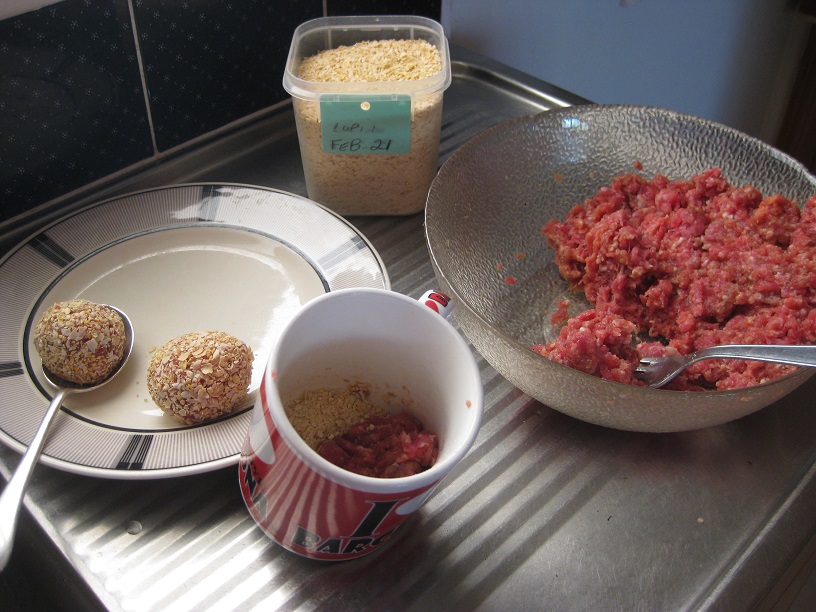
- Place the ball on a plate awaiting the end of forming all the meat balls.
- Check the flour left in the cup and ensure you always have enough flour in the cup to slightly cover a meat ball.
- Make the other balls until you run out of meat. The 500g makes about 12 meat balls.
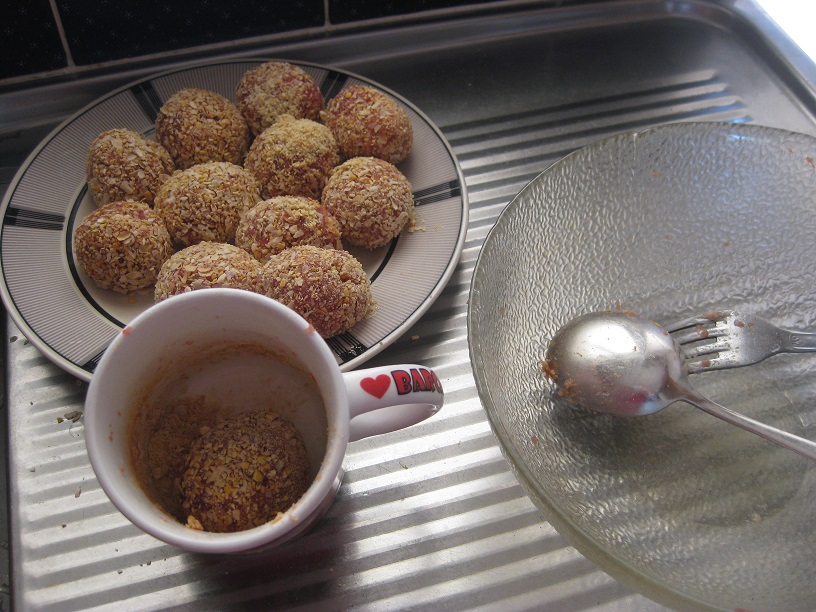
- Use the casserole dish, add some fat (I used to use lamb fat but now have returned to olive oil) and leave to warm on medium heat. Using your tongs, place as many meat balls in the dish as you can fit without crowding them. Let them brown on one side. Using your tongs, turn them onto the opposite side to seal the juices. You may have to brown them in several batches depending on your dish size.
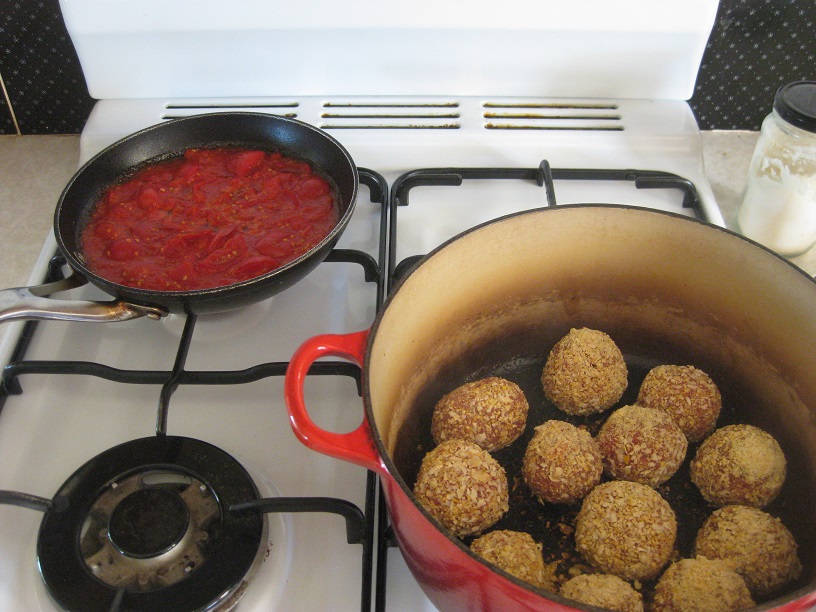
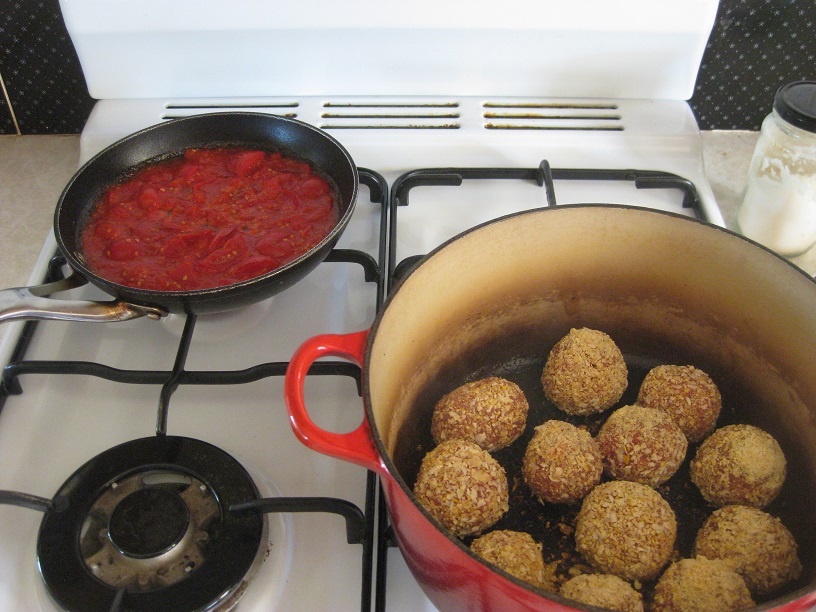
- Once all the meat balls are brown, throw in tomatoes whether already made in a sauce or just cut up. Place the lid and leave on low heat for half an hour or so. Towards the end of the cooking, remove the lid for the tomato juice to evaporate and the sauce to thicken a little.
- Eat with some pasta and a peeled zucchini either raw or fried for a few minutes.
- Gluten Free recipes including Bacon Quiche and Lemon pie.